There has been a lot of discussion recently about how best to support parents, especially of young children. The Trump administration has floated an idea to divert money from childcare to allow married parents to stay home with their children. I doubt this will go anywhere in terms of policy. But it has drawn attention to long-standing debates about care.
The basic question is whether the government should be supporting certain family decisions about how to balance paid work and care in the home. or particular family types.
A crude left-right distinction is that progressives tend to favor policy regimes that promote paid work, especially for women, and so offer subsidies for paid childcare, while conservatives tend to focus on supporting stay-at-home parents. But both sides have typically wanted to put their thumb on the scale, just on opposite ends.
I think it’s time to take both thumbs off the scale, provide parents with the support they need, and then trust them to figure out their work-care arrangements for themselves.
There’s a good article in The Atlantic by Kendra Hurley describing the growing political support for a system of financial support for stay-at-home parents, which, as she writes, “could help reduce the burden on governments trying to implement universal care and give parents with babies an option that many say they want.” Hurley cites a plan proposed two years ago by Representative Ro Khanna and a new idea from the Democrats’ Project 2029 that would provide both support for childcare and care for parents who choose to stay home. As Hurley concludes:
The secret to strengthening the country’s formal child-care infrastructure—counterintuitive as this may sound—may be to pay some parents not to use it.
But I think we need to be honest about the fact that, as far as very young children are concerned, this will lead to a very gendered split.
Hurley cites an excellent survey of parents published earlier this year by New America and NORC, involving 5,472 parents of children under six, that shows that more than a third of parents with children younger than 12 months said their ideal care situation would be to care for their babies themselves throughout the day. Fewer than one in ten said that formal childcare is their preferred option.
As Alyson Silkowski, a senior policy adviser at New America and a co-author of both the Project 2029 proposal and the survey, told Hurley “there is this higher level of discomfort in not being with your youngest child during those first 12 months.”
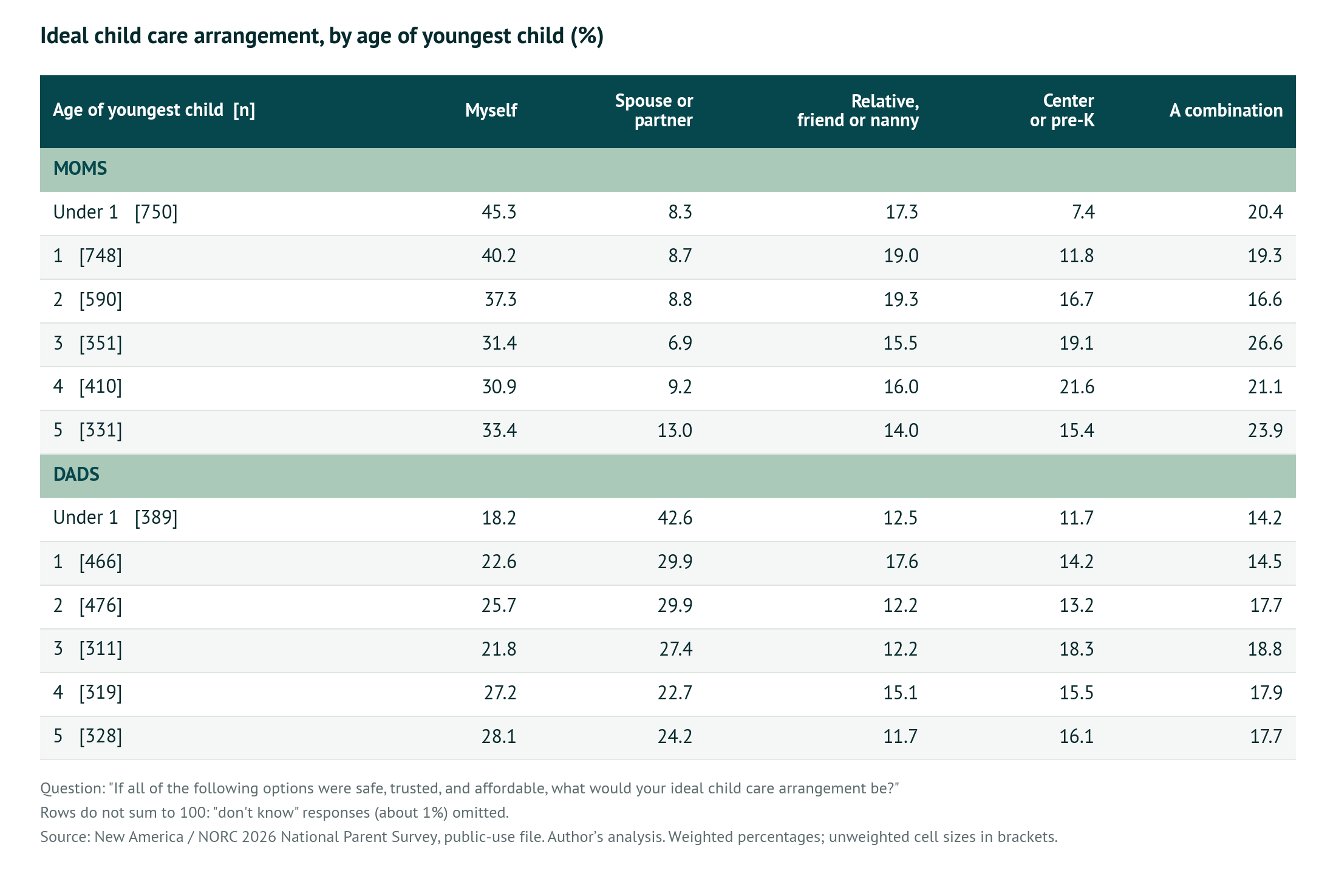
But there is a big gender gap on this question. While 35% of parents overall say they would rather care for their baby themselves, the share for mothers is 45%, compared to 18% among dads. The single number given for parents obscures this 27-point gap. (All the data I present here, including in the charts, is in tables at the bottom of this post, as well as in the data downloads made available by New America and NORC.)
The survey offers an alternative response, that the ideal would be for “my spouse or partner would provide care”, a separate option from “I would provide care myself.” Add these two together and you get the share of parents whose ideal is that a parent is at home with the baby.
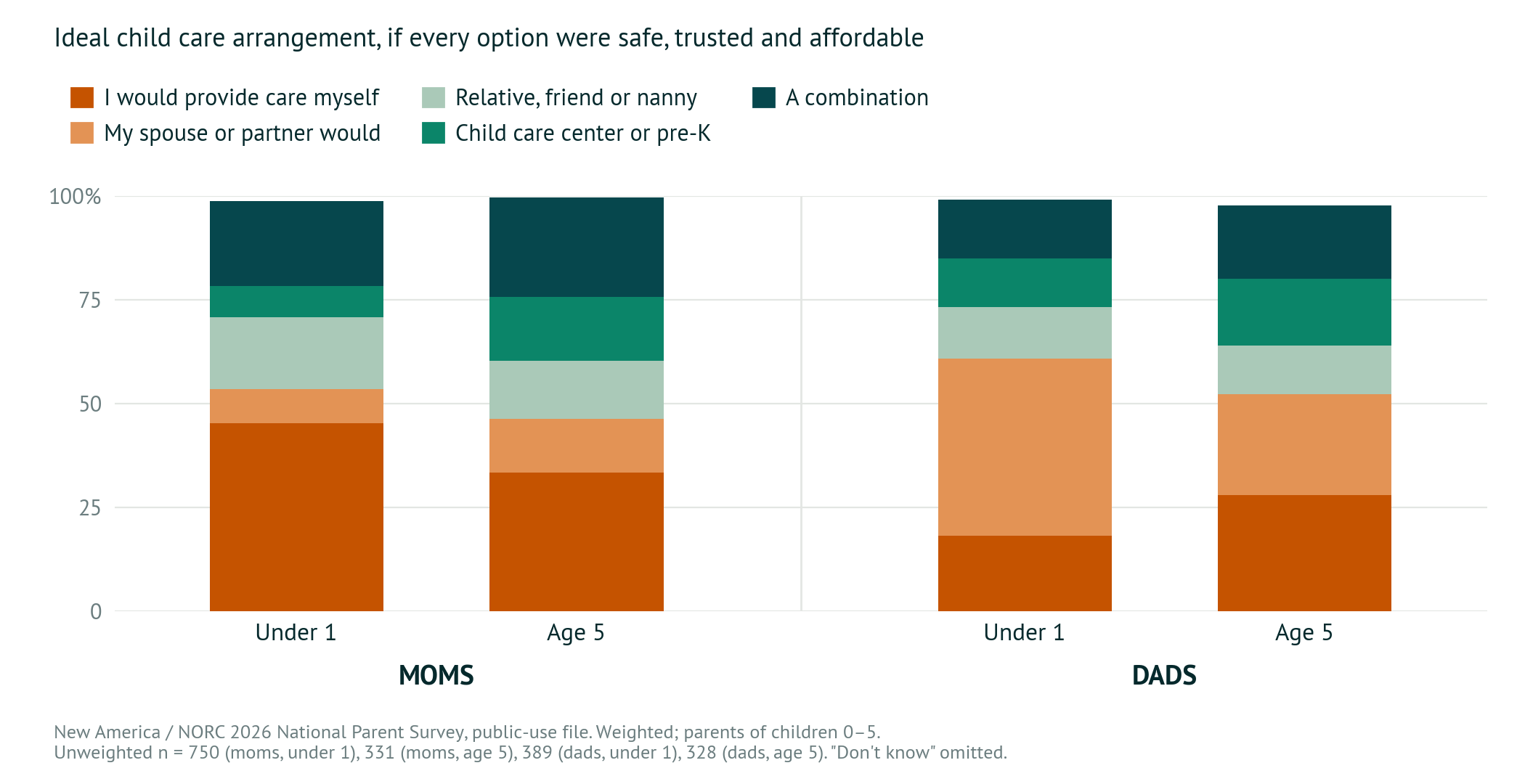
Moms and dads broadly agree that one or the other of them would ideally be caring for their child. The totals are 54% for mothers and 61% for fathers. And they also largely agree that this parent should be the mom. Forty-three percent of dads say their ideal is that their spouse or partner takes care of their baby at home, compared to 18% who say that ideally, they would do it themselves. But before we start throwing too many stones at these dads for their outdated and sexist views, note that the share of moms who say they would prefer to take care of the child themselves is a little higher at 45% - and only 8% say they would prefer their partner or husband to do daddy daycare. Overall, then, both moms and dads want moms to stay at home in the first year, and if anything, that preference is stronger among mothers than fathers.
When children are five years old, however, the picture is very different. Fathers are now more likely to say their ideal is to provide the care themselves (28%) as they are to say their spouse or partner as the ideal carer (24%). About half of parents still prefer that one of them is at home, but especially among dads, they are much more relaxed about which one it is.
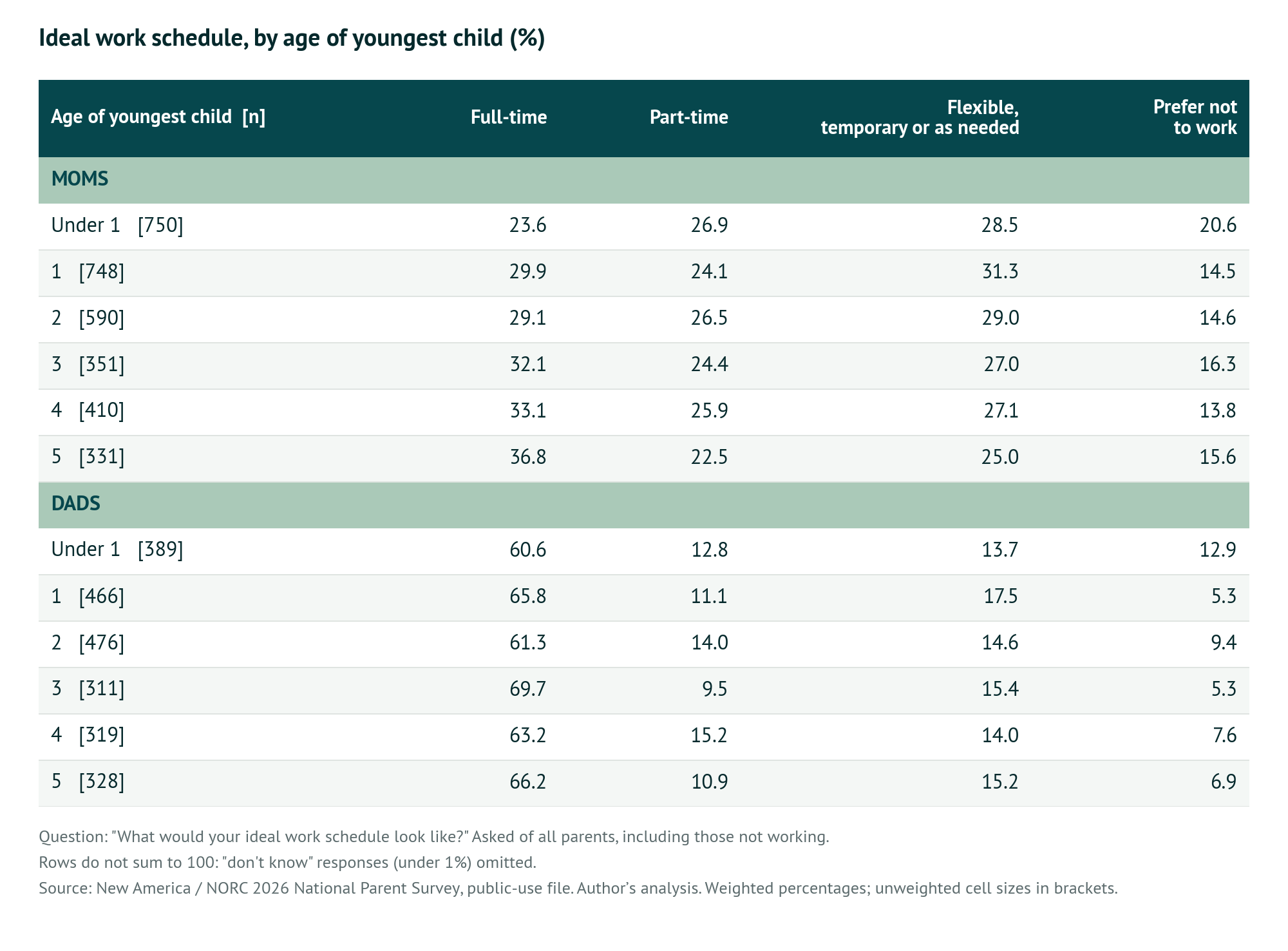
The survey also asks, separately, what the ideal work schedule would look like: full-time, part-time, flexible or as-needed, or prefer not to work. Among parents whose youngest is under one, 61 percent of fathers want full-time work. Among mothers, 24 percent, a thirty-seven point gap.
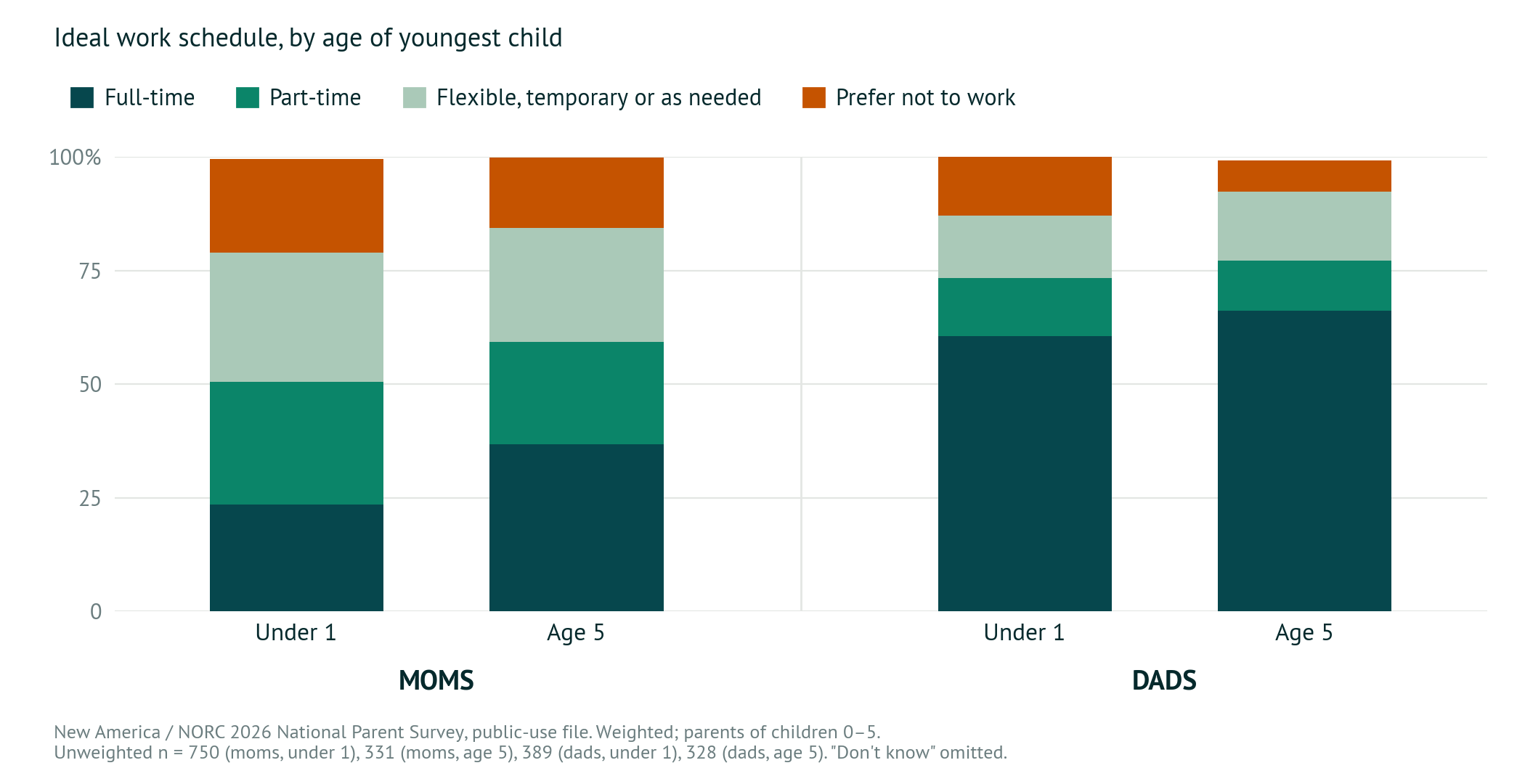
Then the two sexes move differently as the child grows. Mothers’ preference for full-time work climbs thirteen points between infancy and age five, from 24 percent to 37. Fathers’ climbs six, from 61 to 66. Mothers’ working preferences track the age of the child. Fathers’ preferences hardly budge.
This is precisely what worries many progressives about policies to provide more support for stay-at-home parents. They worry, reasonably enough, that in practice this will much more often be mothers than fathers, which will exacerbate gender gaps in the labor market.
I think there are two opposing dangers here. One, more commonly found on the progressive side, is to essentially ignore or wish away what are very clearly stated preferences among the mothers of young children. The second, more often heard from conservatives, is the view that mothers are the parents by default, not just for the first year, but for the first two decades.
We can’t avoid the fact that there are real trade-offs here. As the Nobel Prize-winning economist Claudia Goldin writes, “if a family is also a goal, then something has to give”. That’s right. Not only does something have to give, but something should give if we are to be the kind of parents I think most of us want to be.
It just shouldn’t be only mothers who are doing the giving here. There’s a lot to be said about taking a longer time horizon here, especially when it comes to the perceived fairness of the roles different parents play at different times. It means we don’t need to aim for perfect equality in everything, all the time. Rather, we should be attentive to the distribution of care work and paid work over not just a matter of years, but over the decades it takes to raise children.
What matters is the way in which these divisions of work and care are decided upon, how the respective parties feel about them, and the flexibility to change them as preferences and priorities of the family and of the individuals within it change over time. A new mother is, to use a lovely line from British psychologist Penelope Leach, “a temporarily two-part self”. The key word here is “temporarily.” Even if it is true that mothers have preference for spending more time with their babies and very young children, that does not mean that the division of child-rearing responsibilities is thereafter set in stone.
One of my greatest frustrations in this whole debate is the apparent inability or unwillingness of people to distinguish between a two month old, a two year old and a 12 year old. This is not just early years determinism. It is sometimes early months determinism.
A truly feminist and father-friendly approach will recognize that mothers and fathers will have different desires and preferences at different points in their respective journeys. And that it takes a lot longer than a year to raise children. What I see from both surveys and behavior is a generation of women who want to care for their own children, especially when they’re very young, but who also want the opportunity to pursue a working life. I see growing signs that dads have broadly similar goals, just not necessarily at the same time or in exactly the same way.
Data Tables