
What gender war?
Poison and nonsense online. Progress and common sense in the real world.

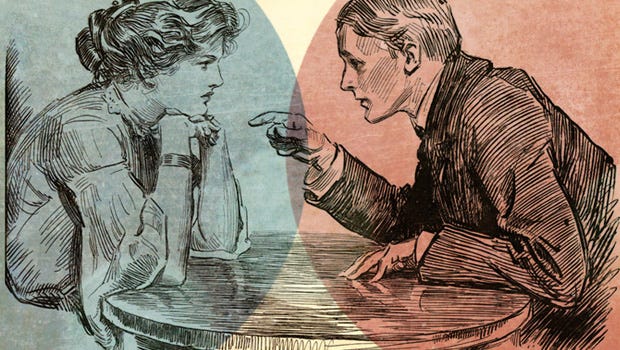
Online, the gender war is raging. Women hate men who hate women. There’s a massive backlash against gender equality and the gains of women. Even perhaps a resurgent misogyny. Or, the feminization of our institutions has rendered them weak, and there is a war against masculinity. There are tradwives and AWFULs, chads and incels. And so on, and on, and on.
In the real world, meanwhile, ordinary men and women are moving peacefully towards a more gender-equal world. Dramatic economic improvements for women are being matched by a huge increase in the amount of domestic work and childcare being done by men. Support for the ideals of gender equality continues to rise. There are more men in our homes caring for kids, and more women in the Houses of Congress, C-suites and state legislatures.
Far from the frontlines of the culture wars, Americans are just getting on with progress.
It’s not really in the interests of either side to point any of this out. Steady progress is pretty boring. It leaves you with nobody to be mad at, nobody to blame, few posts to like. As an attentional strategy, it’s always better to point out what still remains to be done rather than what has already been achieved. This is especially true of political activists. In order to keep the energy up, their media hits coming, and the money flowing, it is necessary for them to remain in a constant state of DEFCON 1.
As Rabbi David Wolpe points out, there is a “psychological reluctance to succeed” in the activist class. The glass must remain half-empty. Progress must be precarious, or patchy, or not artificial. We must always be on the edge of the abyss.
Those with an intellectual orientation are often the worst offenders. Noting steady progress seems a bit, well, dumb. The intellectual glamor is always to be found in the negative. As my hero John Stuart Mill lamented, “it is thought necessary of any man who knows anything of the world to think ill of it”.
I don’t want to downplay the dangers of our polarized culture and politics. I worry a lot about that, in fact. There are bad things being said and done on many fronts. But I’ve come to believe that our salvation will come not from engaging with the nonsense of the culture warriors, but in acknowledging and accelerating the common sense of most of our fellow citizens
There really is some good news on gender equality, roles and attitudes:
Dads doing more parenting and housework than ever
American Dads have massively increased the amount of childcare and housework they are doing. Parents living together work equally hard, whether in unpaid or paid working hours:
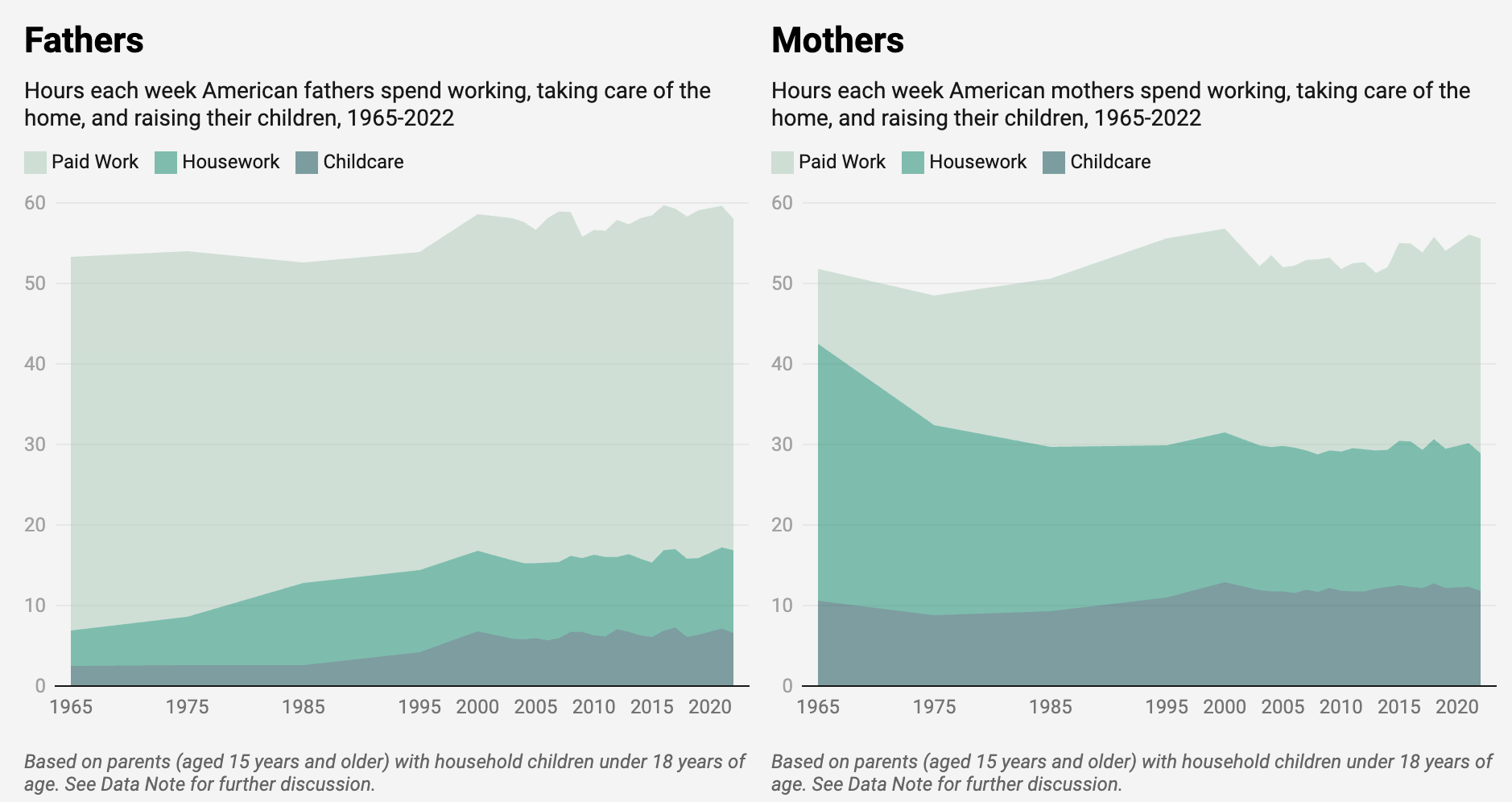
It is true that there’s still a big gender gap in unpaid work among parents: and an equal one in paid work. But that gap is narrowing. One factor keeping the gap pretty wide on the parenting front is that mothers are doing more parenting than before, even as they do more paid work too. It’s hard to catch up with a moving target.
In recent years there’s been an even more dramatic shift towards parenting and domestic work among American fathers, as shown in a groundbreaking paper for AIBM from Ari Binder, “Gender Convergence in Couples’ Time Use Following the COVID-19 Pandemic”.
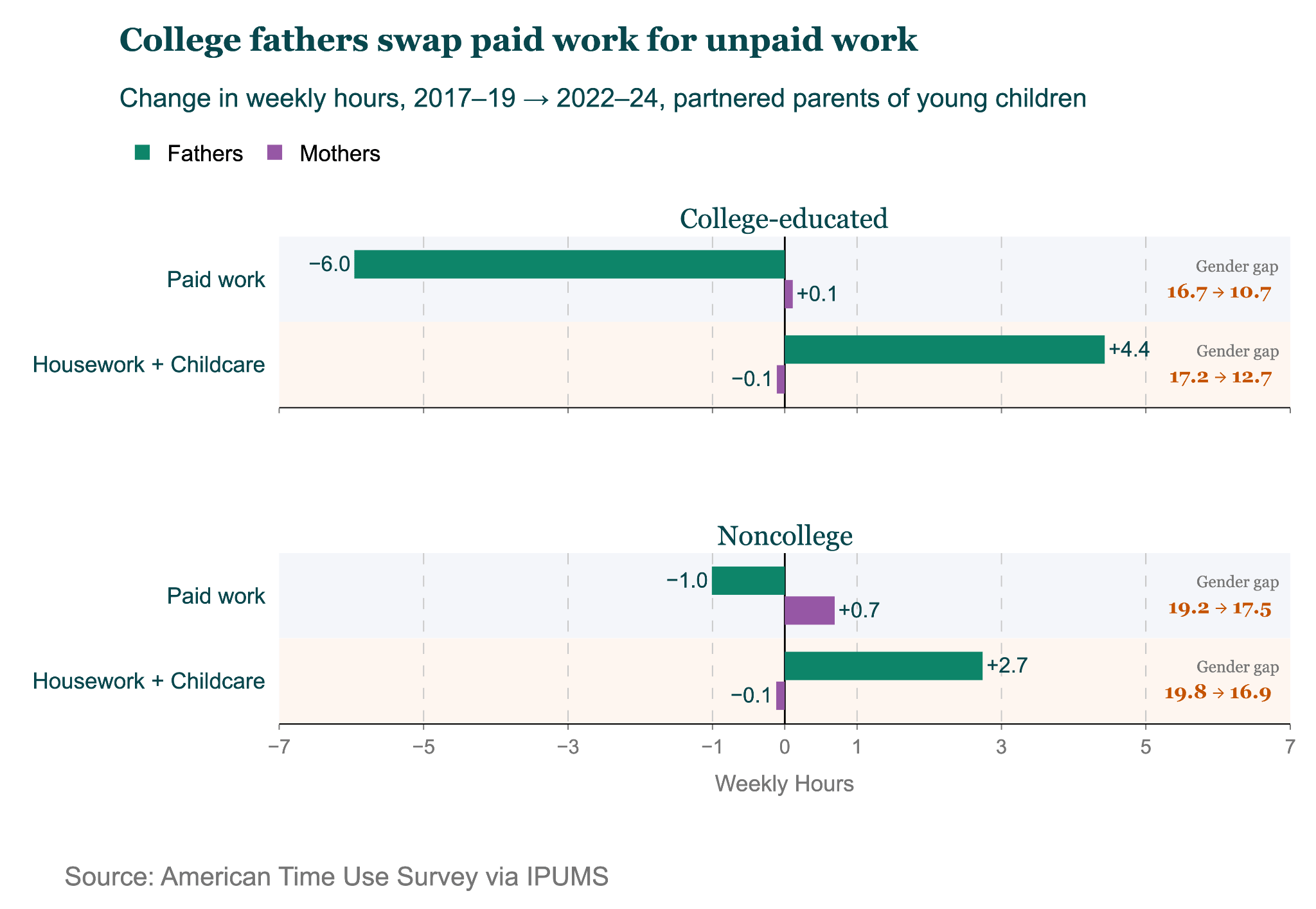
As you can see, the really big changes have been among college-educated Dads. But these professional couples get a lot of the cultural attention when it comes to gender roles and gendered divisions of labor. There’s lots more in Ari’s paper which I thoroughly commend, and which I’ll be coming back to on these pages for sure.
But the bottom line is that the accelerating trend is towards a more equal share of work between men and women, especially those with young children.
Women hitting new highs in the workplace
Labor force participation among prime age women (25-54) has reached 78%, the highest level on record, (and four percentage points higher than when Donald Trump first entered the White House). There are also currently more women than men in payroll jobs.
This is not to say that the gender gap has closed (it hasn’t, yet), or that women don’t still face barriers in and into the labor force (they do, especially given the division of family responsibilities). It is simply to say that the narrative of the tide turning back against women’s progress is hard to square with these facts on the ground.
OK, but what about women in leadership roles? Perhaps women are only doing low-paid, low-status jobs. Well, no. According to Lean In, the share of women in the C-suite has increased from 17% to 29% in a decade. This is truly remarkable progress. Does it mean there’s not more to do? No! For one thing the rise in the level below is not as impressive, raising concerns about the future. For another, the particular roles held by women on Boards remain highly gendered. But again, the point is simply that there has been a striking surge of women into the most senior positions in business since 2015.
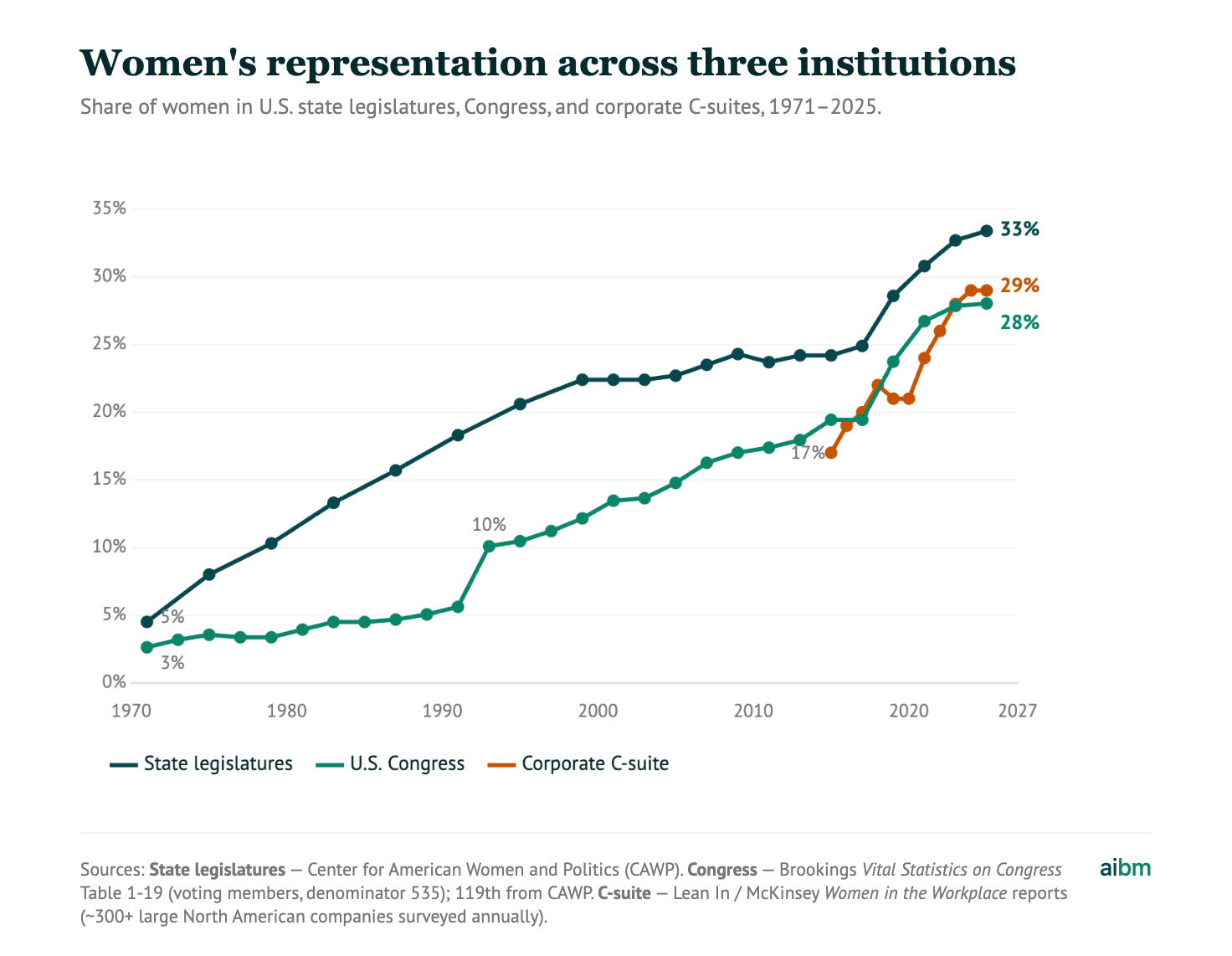
What about in political leadership? Again, pretty good news here. The share of members of Congress who are women has been rising, almost tripling since the early 1990s. Again, clearly more to do here (and I’ve argued at Brookings for quota systems on this front). But still, impressive progress.
It’s been even better news in state legislatures, where the share of women is now 1 in 3. The U.S. lags other nations in terms of gender representation in politics, in part because of constitutional obstacles to more aggressive approaches used elsewhere, like quotas. So the progress has been slower than elsewhere. But it is progress nonetheless.
Support for gender equality is high and rising
One dominant stand of the online gender-war story is that men, and especially young men, are turning against women or at least against the ideals of gender equality. But the evidence for this is very weak, and based on a particular interpretation of cherry-picked surveys. Among many recent examples, an essay by Helen Lewis in the Atlantic magazine on the rise of “masculinism” in the U.S. provided the following evidence for the popularity of misogynistic ideas:
Last year, research by King’s College London and Ipsos found that Gen Z men in 30 nations were far more likely than male Baby Boomers to say that the fight for women’s equality had gone so far that men were now disadvantaged. They were also more than twice as likely to say that a father who stayed home with his children was “less of a man.”
I know that survey well. It’s one of many on this topic, and contains some useful information. But it is a pretty thin reed on which to base such sweeping claims. Lewis also failed to mention that the same trend can be seen among Gen Z women. Another real challenge here is that those 30 nations show very different findings. It includes some with quite traditional cultures including Thailand, India, Mexico, Turkey, Chile and Malaysia.
American men were more enlightened than most. In the U.S., 47% of men agreed with the statement about men now being disadvantaged. We can argue about what these men had in mind, along with the 33% of women who also agreed. But it is striking that an equal or higher share of men in the following countries also agreed with that statement: Sweden, Holland, Canada, Ireland, Great Britain, Spain, New Zealand, Australia, Belgium and many others.
Again, this is not to discount the findings. It is to say that when the Dutch and the Swedes are on the same page as us, it’s a much more complex story than a simple one about the U.S., or the nature of the American right. Only 16% of men and 13% of women in the U.S. agreed with the statement that a stay-at-home Dad is “less of a man”, well below the international average.
The deeper problem here is that there are lots of different surveys asking different questions in different countries in different years, each very open to different interpretations, both by the respondents and the pollsters. Everyone is at risk of believing the ones that confirm their priors and ignoring the others. And honestly, many of the questions in some surveys seem designed to elicit a certain headline.
What we need is some questions that have been asked repeatedly over time in a representative high-quality survey, on an aspect of gender equality that is less vulnerable to short-term trends or subjective interpretation.
Good news: we have them! The U.S. General Social Survey has been asking some gender questions for a long time. Here’s a solid one:
“It is much better for everyone involved if the man is the achiever outside the home and the woman takes care of the home and family.”
This gets at attitudes towards basic gender roles. (I’ve worked with Allen Downey on this). So let’s see what’s been happening in terms of levels of disagreement with this question. For gender egalitarians, the news is very good (trend lines smoothed because year-on-year data points can be noisy):
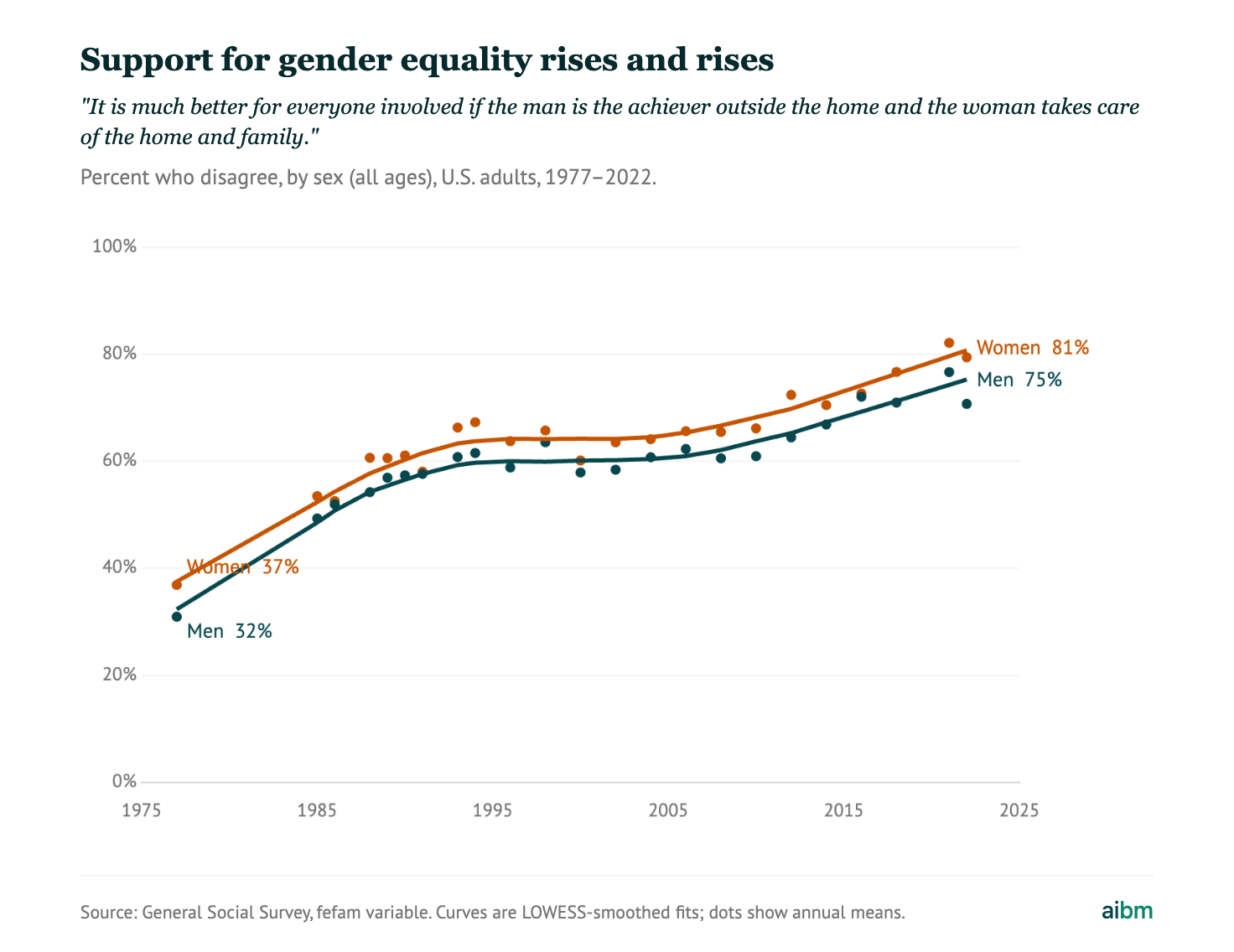
Almost in lockstep, American men and women are continuing to move away from the traditional view about gender roles in the family.
OK, so maybe people are becoming more egalitarian about family roles. But what about politics? Isn’t there a rise in sexism there? Well, I don’t think so. In the past, the GSS had a question about support for a female candidate for President, namely: “If your party nominated a woman for President, would you vote for her if she were qualified for the job?” But this was dropped in 2010 when the level of support hit 96%.
There is still a politics-related agree/disagree question in the GSS though:
“Most men are better suited emotionally for politics than are most women.”
On this question too, the march of progress continues, with the share disagreeing rising to 84% among men and 87% among women in the most recent year:
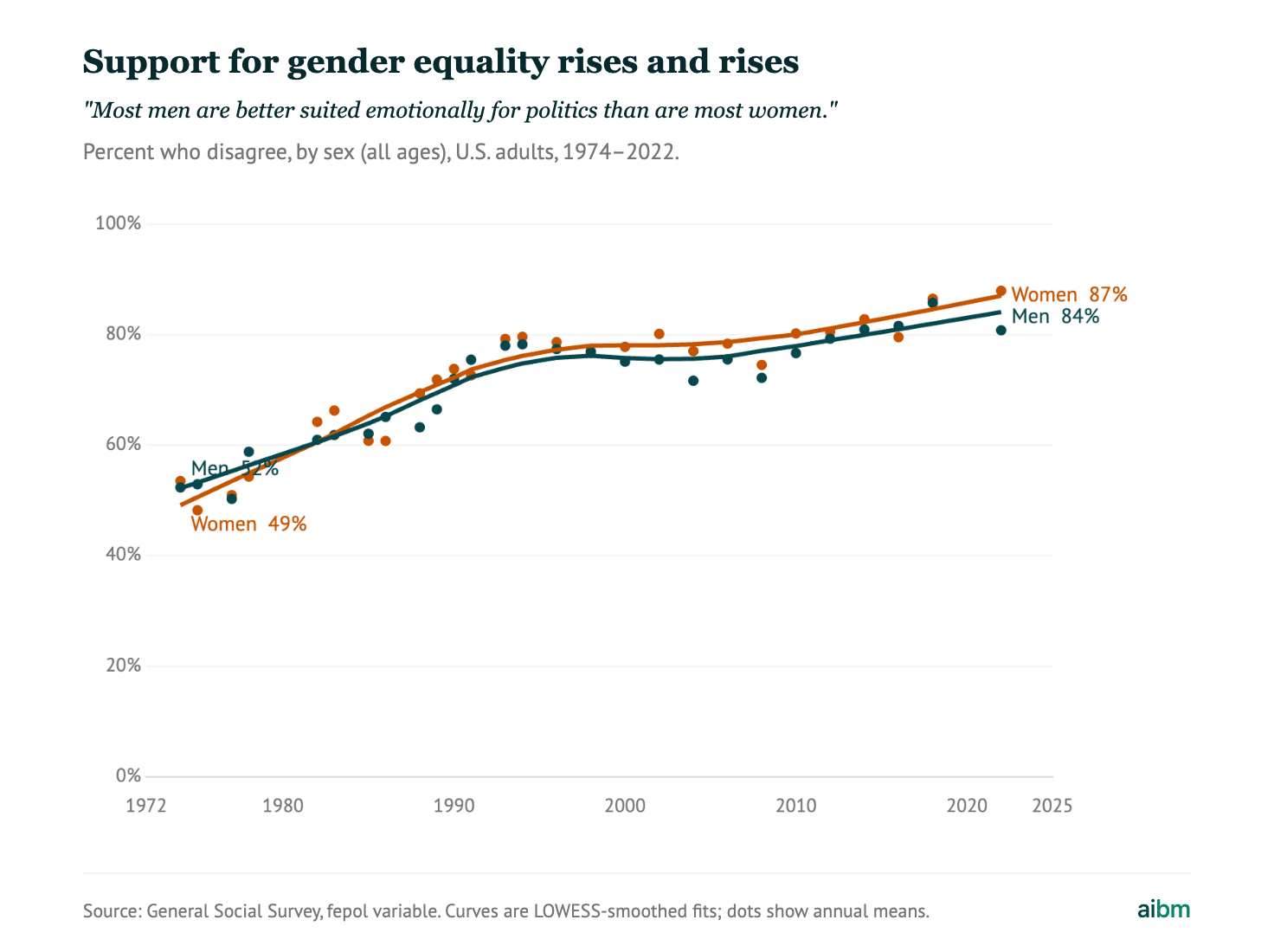
Sure, you could see this glass as half-empty, and highlight the small and shrinking share of men and women who agree with this statement. But given that we were split 50/50 on it during my lifetime, I think it’s more appropriate to highlight the real progress on this one, too.
The bottom line here is that when we use the best surveys in a good faith way, the evidence for a retrenchment just isn’t there. Boring, I know.
Don’t Panic
I’ve shown mostly pretty long-term trends here. That’s largely because I think people tend to over-react to short-term apparent changes which often wash out over time. It’s also because I want to emphasize that progress rarely happens very quickly. It’s a long march. What matters most is that it is in the right direction. There are also lots of other areas I’ve not covered: crime, mental health, etc.
I realized writing this that it now feels more risky to tell stories of progress and advance than to sound the alarm bells about an area of legitimate concern (which is something I do too, to be clear).
There’s a bunch of reasons for this. I’ve already mentioned the need among activists to always be losing. There’s also a fear that acknowledging progress could lead to complacency. For what it’s worth, I’m more worried now that failing to acknowledge progress fuels fatalism.
When it comes to gender, I’m as encouraged by the trends in the real world as I am discouraged by the unending culture war rhetoric. To be clear, there are a lot of cultural trends we need to be watching closely. But based on real-world trends, toxic cultural messages seem to be having little impact on everyday life.
It is American men and women who are leading the way, not the “influencers” who get so much unwarranted attention.